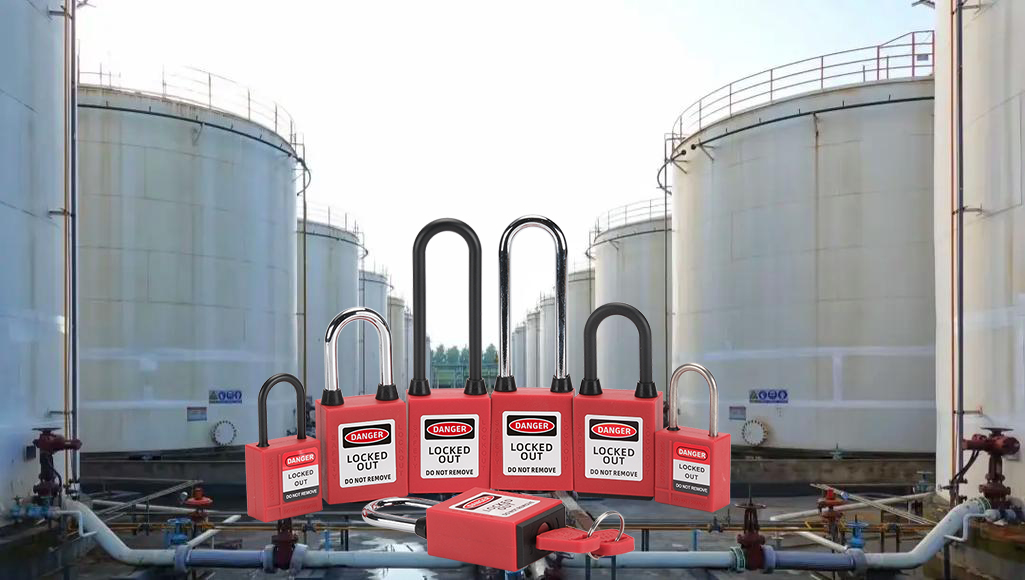

I. The High-Risk Nature of Petrochemical Plants Dictates the Rigid Demand for LOTO Padlocks
The production characteristics of petrochemical plants create an extreme need for hazardous energy control. LOTO padlocks are the core tool to meet this need; their use is not optional. This necessity is demonstrated across three core aspects:
1. Comprehensive Coverage of Work Scenarios: Every Maintenance Task Requires LOTO Padlock Protection
The demand for LOTO padlocks in petrochemical plants spans the entire production process and covers all high-risk work scenarios. Almost any operation involving equipment shutdown and energy isolation requires the use of LOTO padlocks, with no viable substitutes or omissions.
Core scenarios include: routine maintenance and periodic servicing of key production units such as crude distillation units, catalytic cracking units, and hydrotreating units; cleaning, repair, and leak sealing of pipelines, storage tanks, and reactors; power-off maintenance of electrical equipment (transformers, switchgear, motors); start/stop debugging and maintenance of valves and pumps; and maintenance of storage equipment for flammable, explosive, or toxic media. In all these scenarios, whenever energy (electrical, hydraulic, pneumatic, media transfer) needs to be cut off to prevent accidental equipment startup or energy release, LOTO padlocks must be used to lock the isolation devices (e.g., valves, switches, circuit breakers), and warning tags must be hung to clearly indicate Equipment Under Repair – Do Not Operate.
For example, during reactor maintenance, feed and discharge valves must be closed and locked with LOTO padlocks to prevent accidental opening, which could lead to leaks of toxic, flammable, or explosive media. During motor maintenance, the power switch must be disconnected and locked with a LOTO padlock to prevent accidental switch closure that could start the motor and cause mechanical injury.
2. Extreme Consequences of Risks: LOTO Padlock is a "Life-Saving Lock," Not an "Optional Tool"
The consequences of hazardous energy out of control in petrochemical plants are far more severe than in general industry. A single failure to properly use a LOTO padlock can trigger a catastrophic accident. Industry data shows that approximately 30% of safety accidents in the global petrochemical industry are related to hazardous energy out of control, with over 80% of those caused by failure to follow LOTO procedures or use LOTO padlocks.
Imagine a scenario during pipeline repair: without locking the valve with a LOTO padlock, another worker accidentally opens the valve. High-pressure crude oil sprays out instantly, igniting an explosion upon contact with an ignition source. This could not only injure or kill maintenance personnel but also shut down the entire production unit and cause environmental pollution, with economic losses easily reaching tens of millions or even hundreds of millions of RMB. LOTO padlocks provide physical locking, blocking this risk at its source, serving as a "life insurance policy" for workers. The necessity is undeniable. Accidents caused by improper LOTO padlock use are frequent globally. A prime example is the 2005 Buncefield oil depot explosion in the UK. While primarily caused by a level gauge failure, the subsequent investigation found that LOTO procedures were not strictly followed during related maintenance work; the feed valve was not locked with a LOTO padlock, preventing timely isolation of the fuel flow. The resulting leak of 250 m³ of gasoline formed a vapor cloud that exploded, destroying 20 large storage tanks, causing property damage to 630 businesses, and severely polluting the surrounding environment. This accident became a key global warning case emphasizing the importance of LOTO padlocks. A similar tragedy occurred at a domestic petrochemical enterprise. During reactor maintenance, workers only hung a warning tag without locking the feed valve with a LOTO padlock. A colleague mistakenly opened the valve, causing a toxic media leak that poisoned three maintenance workers. The company was ordered to suspend operations for rectification and faced heavy fines, fully demonstrating the irreplaceable life-saving role of LOTO padlocks in petrochemical settings.
3. Mandatory Legal Requirements: Compliance is the Bottom Line for Enterprise Survival
Globally, the petrochemical industry, being high-risk, is subject to mandatory LOTO regulations. As the core component of LOTO procedures, the provision and use of LOTO padlocks are fundamental requirements for compliant operations and are important items for obtaining and renewing safety production permits.
In China, standards GB/T 33579-2017 ("Safety of machinery - Energy control methods - Lockout/tagout") and GB/T 44686-2024 ("Safety of machinery - General principles for hazardous energy control") explicitly mandate the use of LOTO safety padlocks in high-risk industries like petrochemicals during equipment repair and maintenance, prohibiting the use of ordinary民用 padlocks as substitutes. Emergency management departments include LOTO padlock compliance as a key focus in special safety inspections. Enterprises failing to provide or properly use them face orders for rectification, substantial fines, and in severe cases, suspension of operations.
In Europe and the US, standards like OSHA 29 CFR 1910.147 (US) and Directive 89/655/EEC (EU) mandate the use of LOTO padlocks for petrochemical enterprises. Non-compliance leads to hefty fines, accountability for responsible personnel, and even revocation of operating licenses. For petrochemical plants, equipping sufficient, compliant LOTO padlocks is not an "extra expense" but a necessary compliance obligation and key to mitigating legal risks.
II. Petrochemical Plant Demand Characteristics for LOTO Padlocks: High Volume, Stringent Standards, Strong Scenario Adaptability
Compared to general industrial enterprises, petrochemical plants demand LOTO padlocks not only in large quantities but also with stringent standards and strong adaptability to special operating conditions like high temperature, high pressure, corrosion, and explosion protection.
1. Large Quantity Demand, Covering Numerous Points
A medium-sized petrochemical plant has hundreds of energy isolation points (valves, switches, circuit breakers, etc.). Each point requires at least one LOTO padlock. Including those needed for different maintenance teams and tasks, plus spares, a medium-sized plant typically needs hundreds or even over a thousand LOTO padlocks. Large petrochemical complexes, encompassing multiple production units, storage areas, and pipelines, may require thousands of LOTO padlocks, with continuous replenishment as scenarios and equipment are added or updated. Furthermore, high frequency of use and exposure to harsh environments lead to wear and require regular replacement, further blow up the demand scale.
2. Stringent Quality Standards for Extreme Conditions
The complex petrochemical environment—high temperature, high pressure, high corrosion, flammability, explosiveness, toxicity—imposes extremely high quality requirements on LOTO padlocks. Ordinary industrial padlocks cannot meet these needs.
Core requirements include: materials must be high temperature resistance, corrosion-resistant, pry-resistant, and explosion-proof, typically using stainless steel or high-strength engineering plastics to avoid deformation or corrosion under high temperature or spark generation in flammable atmospheres. The lock body needs anti-replication features and unique key coding to prevent unauthorized opening and ensure locking reliability. Padlock tags must be clear, durable, and remain visible in harsh environments, displaying warnings like "Do Not Open – Equipment Under Repair". Some scenarios require waterproof and dustproof padlocks for outdoor, humid, or dusty areas. Major domestic petrochemical enterprises have mature LOTO padlock adaptation standards. For example, Dalian Petrochemical Branch of Petro China equips its high-risk units (hydrocracking, catalytic reforming) with explosion-proof LOTO padlocks made of non-sparking alloys, certified for use in flammable atmospheres, effectively avoiding spark risks. Zhenhai Refining & Chemical Branch of Sinopec equips its high-temperature areas (distillation units) with high-temperature resistant stainless steel LOTO padlocks capable of withstanding 250°C continuously, ensuring lock integrity under extreme conditions. These practical cases precisely address petrochemical scenarios and demonstrate high standards and demands.
3. Strong Scenario Adaptability: Requires Categorized Provision
Different scenarios in petrochemical plants have different requirements for LOTO padlocks, necessitating categorized provision, not a "one-size-fits-all" approach. For example:
● High-temperature scenarios (e.g., distillation units, around heaters):Require high-temperature resistant LOTO padlocks, able to withstand temperatures exceeding 200°C to prevent softening or failure.
● Flammable/explosive scenarios (e.g., storage tanks, hydrogenation units):Require explosion-proof LOTO padlocks with non-sparking design to prevent spark generation during locking/unlocking.
● Multi-worker maintenance scenarios (e.g., large equipment repair):Require group LOTO padlocks (combination locks) allowing multiple workers to apply their own locks; the equipment can only be started after all workers remove their locks, ensuring collaborative safety.
● Outdoor, damp scenarios (e.g., outdoor pipeline repair):Require waterproof, corrosion-resistant LOTO padlocks to prevent damage from rain or corrosive media, maintaining locking effectiveness.
III. Risks for Petrochemical Plants Neglecting LOTO Padlock Demand
Neglecting LOTO padlock demand—failing to provide sufficient, compliant padlocks or failing to use them properly—exposes plants not only to legal penalties but also to irreversible safety risks and economic losses.
1. Safety Risks:Triggering major accidents like explosions, fires, toxic leaks, causing casualties and damaging production facilities. For instance, at a large domestic petrochemical refinery during hydrotreater reactor maintenance, the team only hung a warning tag without locking the hydrogen feed valve with a LOTO padlock. A patrol worker mistakenly believed the equipment was idling and opened the valve, releasing high-pressure hydrogen that exploded upon contact with maintenance sparks. This resulted in 2 fatalities, 3 injuries, severe reactor damage, nearly a month of shutdown, and direct economic losses exceeding ten million RMB. This case directly confirms the deadly risk of lacking LOTO padlock protection in petrochemical settings.
2. Legal Risks:Violation of national and local safety regulations leads to rectification orders, substantial fines, suspension of operations in severe cases, revocation of safety production permits, and potential criminal liability for responsible persons. In 2024, a local petrochemical enterprise was found during a special inspection by emergency management authorities to have failed to equip critical points (pipelines, storage tanks) with required LOTO padlocks and not using padlocks properly for some maintenance. The company was fined 1.2 million RMB, had its safety production permit suspended, and its safety manager faced legal accountability. High-risk operations were completely halted during a mandated rectification period. This fully illustrates the binding effect of regulations regarding LOTO padlock use in petrochemical plants and highlights the importance of compliant provision and proper use.
3. Economic Risks:Accidents lead to production shutdowns, equipment damage, environmental remediation, and massive economic losses. Non-compliance can also damage corporate reputation and lose business opportunities.
4. Management Risks:Improper LOTO padlock use can lead to confused work processes, operational errors, unclear responsibility, amplifying safety hazards.
IV. Conclusion: LOTO Padlock – The Irreplaceable Safety Necessity for Petrochemical Plants
In summary, the high-risk production characteristics, mandatory legal requirements, and core operational safety needs of petrochemical plants dictate that the demand for LOTO padlocks is "rigid and urgent." LOTO padlocks are not an optional "auxiliary tool" but a "core defense line" protecting worker safety, preventing major accidents, and ensuring compliant operations.
As global petrochemical safety standards rise and corporate safety awareness increases, the demand for LOTO padlocks will not only remain stable but will also evolve towards "high-quality, scenario-specific, and intelligent" solutions (e.g., smart LOTO padlocks enabling remote monitoring and unlocking record traceability). For petrochemical enterprises, prioritizing the provision and proper use of LOTO padlocks is both a social responsibility and a key measure to mitigate risks and achieve sustainable development. For industry professionals, understanding the specific demand characteristics for LOTO padlocks in petrochemical plants helps grasp safety trends and contribute to improved industrial safety levels.